
Palestine
Following the Sykes-Picot agreement (1916), ‘Mandatory Palestine’ was established as a British administrative territory between 1920 and 1948. The Balfour Declaration (1917) simultaneously enabled Zionist colonisation and lay the foundations for the ongoing displacement and genocide of the native Arab population.
—
Designed digitally with Procreate in 2026,
Physical edition in the backlog
Species featured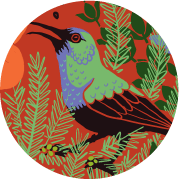
Palestine Sunbird
Cinnyris oseus
The Palestine Sunbird — Cinnyris oseus, named for the territory — is among the few species in the world that carry a national name now under active political contestation. It was described and named by ornithologists working in Mandatory Palestine in the nineteenth and early twentieth centuries, when the territory's geographic identity was not in dispute. The male, in breeding plumage, is iridescent blue-black with a metallic sheen that shifts from green to purple in different light — a bird that is visually unremarkable in silhouette and extraordinary in detail, visible only to those paying close attention. It is the national bird of Palestine. Its range corresponds almost exactly to the territory of historic Palestine — the Jordan Valley, the coastal plain, the Galilee, the West Bank hill country. It does not recognise the Green Line. It nests in gardens, olive orchards, and scrubland across the landscape, wherever flowering plants provide nectar. Its population is not globally threatened, but its habitat — the agricultural landscapes and wild margins of a territory under prolonged military occupation and settlement expansion — is under sustained pressure. The bird that carries Palestine's name lives in a landscape whose transformation it cannot interrupt and does not understand.
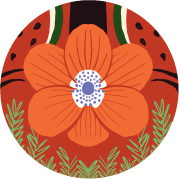
Crown Anemone
Anemone coronaria
Tthe crown anemone covers the hillsides and field margins of historic Palestine in deep red through the winter months, one of the first flowers of the agricultural year and one of the most embedded in Palestinian visual culture, poetry, and the iconography of land attachment. Mahmoud Darwish, the Palestinian national poet, wrote of the anemone as a figure for the land itself — not as a symbol of loss but as evidence of presence, of a living relationship between a people and a specific place that outlasts the political arrangements imposed upon it. The flower grows where it has always grown, without permission and without documentation. In Palestinian embroidery — tatreez, the cross-stitch tradition that encodes regional identity in its patterns — anemone motifs appear in the needlework of specific villages, identifiable by those who know the tradition as markers of origin as precise as any passport. The embroidery tradition survived the Nakba, carried in the hands and memories of women who brought their needles and their patterns into exile. The flower is still blooming on the hillsides of the West Bank and Galilee. The villages whose embroidery recorded it are, in many cases, gone.
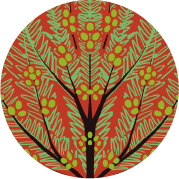
Olive Tree
Olea europaea
The olive tree is the oldest cultivated tree in the Palestinian landscape — some individual trees in the West Bank are estimated to be over three thousand years old, their gnarled trunks and continuous productivity representing an unbroken relationship between a family and a piece of land that no legal document has ever adequately captured or protected. The olive harvest, which takes place in October and November, is the central agricultural and social event of the Palestinian rural year: families return to their trees, extended communities gather, the harvest is shared and pressed. Since 1967, and accelerating significantly since the 1990s, olive trees have been among the primary targets of both settler violence and Israeli military and administrative action in the occupied West Bank: uprooted by bulldozer to make way for settlement construction, road-building, and the separation barrier; burned by settlers; and made inaccessible by movement restrictions that prevent Palestinian farmers from reaching their own trees during the harvest window. United Nations and human rights organisation documentation puts the number of olive trees uprooted or destroyed since 1967 at over 800,000. The olive tree does not die easily — its root system can regenerate shoots from stumps left in the ground. The uprooting of Palestinian olive trees is therefore not incidental agricultural clearance but a deliberately targeted act against the specific form of continuous, rooted relationship to land that the olive tree represents.
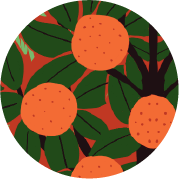
Jaffa Orange
Citrus sinensis — Shamouti variety
The Jaffa orange — the Shamouti variety, thick-skinned, nearly seedless, sweet — was developed by Palestinian Arab farmers in the groves around Jaffa in the nineteenth century and became one of the most commercially successful agricultural exports in the Ottoman Levant. By the early twentieth century, Palestinian citrus groves employed tens of thousands of workers across the coastal plain, and the orange was among the most recognised agricultural products in European markets. Under the British Mandate, Jewish agricultural cooperatives also developed citrus production, and the industry became dual — Arab and Jewish — and commercially significant to both communities. In 1948, the displacement of the Arab population from the coastal plain and the Jaffa region transferred the majority of Palestinian citrus groves to the new state. The Jaffa orange became an Israeli export brand. Palestinian farmers who had developed and cultivated the variety for generations lost their groves without compensation. The brand name survived the dispossession that made it possible. It is now one of the most successful agricultural branding exercises in the world, and one of the least examined.
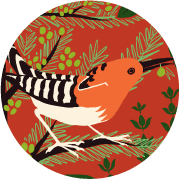
Hoopoe
Upupa epops
The hoopoe appears in the Quran as the bird that carried messages between the Prophet Suleiman and the Queen of Sheba — a bird of wisdom, communication, and the carrying of news across distances. In the Hebrew Bible it is listed among the birds of the land. It has been present in the art, literature, and folklore of this territory for as long as those traditions have existed, across every religious and cultural community that has inhabited it. In 2008, a public vote of over 155,000 Israelis elected the hoopoe as Israel's national bird. In 2015, the Palestinian Authority designated the Palestine Sunbird as Palestine's national bird. Two birds for the same landscape — the hoopoe chosen by the state that administers it; the sunbird chosen by the people to whom it has belonged. The Palestine Sunbird was, in fact, a losing candidate in the 2008 Israeli vote in part due to the name. Both birds nest in the same olive groves. In Persian poetry, the hoopoe leads the birds of the world toward enlightenment and toward home. The hoopoe of this landscape nests in the walls of old stone houses, in the ruins of villages, in the crevices of whatever structure remains standing.
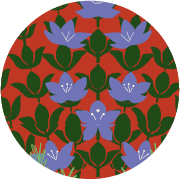
Za'atar
Origanum syriacum
Origanum syriacum — za'atar, wild thyme — grows across the rocky hillsides of the Levant, its dried leaves ground with sesame, sumac, and olive oil into the condiment that carries its name and that is present on every Palestinian breakfast table, in every diaspora kitchen, in every community that has carried its food culture into exile. Za'atar is not merely a spice — it is a site of cultural memory, a marker of origin, and a form of attachment to a specific landscape that survives displacement. The plant itself grows wild across the West Bank and Galilee; under Israeli military administration, it was designated a protected species in 1977, making its harvesting by Palestinians illegal. Human rights organisations and Palestinian farmers have documented this designation as operating in practice as a restriction on Palestinian access to their own wild landscape, while settlement agricultural operations continued. Za'atar's legal protection in Israel and the occupied territories has been contested precisely because the plant is so deeply embedded in Palestinian cultural identity that restricting its harvest functions as a form of cultural enclosure.
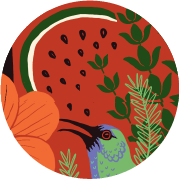
Watermelon
Citrullus lanatus
The watermelon became a political symbol in Palestine in the 1960s and 1970s when the display of the Palestinian flag was prohibited under Israeli military law in the occupied territories: its red flesh, white rind, black seeds, and green skin — the four colours of the Palestinian flag — made a watermelon slice an act of symbolic defiance that could not be legislated against without absurdity. The image circulated globally and became one of the most widely recognised pieces of Palestinian political iconography. The fruit itself has a deeper agricultural history in the region: watermelon cultivation has been documented in the Levant for millennia, and it was a staple crop of Palestinian village agriculture across the coastal plain and the Jordan Valley. The symbol's power derives precisely from its ordinariness — the most common fruit of the summer table, carrying the colours of a flag that could not be shown. After the Oslo Accords, the flag prohibition was lifted. The watermelon remained. In 2023, following restrictions on Palestinian flag displays in some international contexts, the watermelon emoji circulated globally as a marker of solidarity. The fruit that was once contraband is now a digital flag. The displacement it represents has not ended.
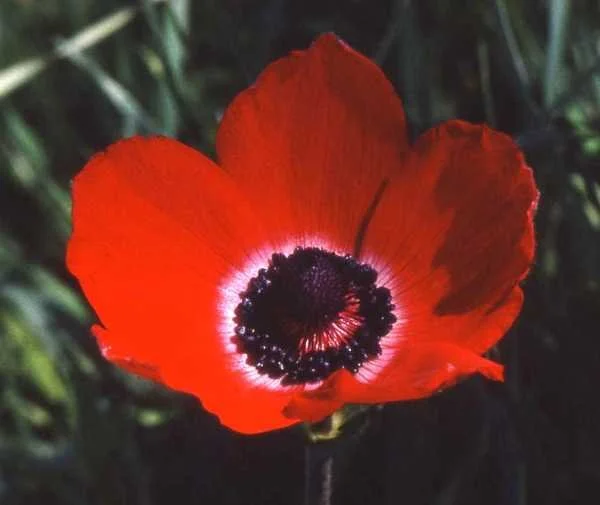
Color ThemeAnemone Red
The crown anemone (Anemone coronaria)—known in Arabic as shaqa’iq an-nu’man (شقائق النعمان) or hanoun—is the national flower of Palestine. Its brilliant red color and delicate petals symbolize indigenous Palestinian heritage, resilience, and the blood of those who have lost their lives in the struggle for the nation. Beyond the red petals, the crown anemone holds profound significance because its anatomy encapsulates all four colors of the Palestinian flag: Red in the petals (martyrdom and struggle), Black in the dark center, White surrounding the center, and green in the stem.