
An ongoing visual meditation on history & ecology, ownership & thievery, beauty & violence, colony & empire
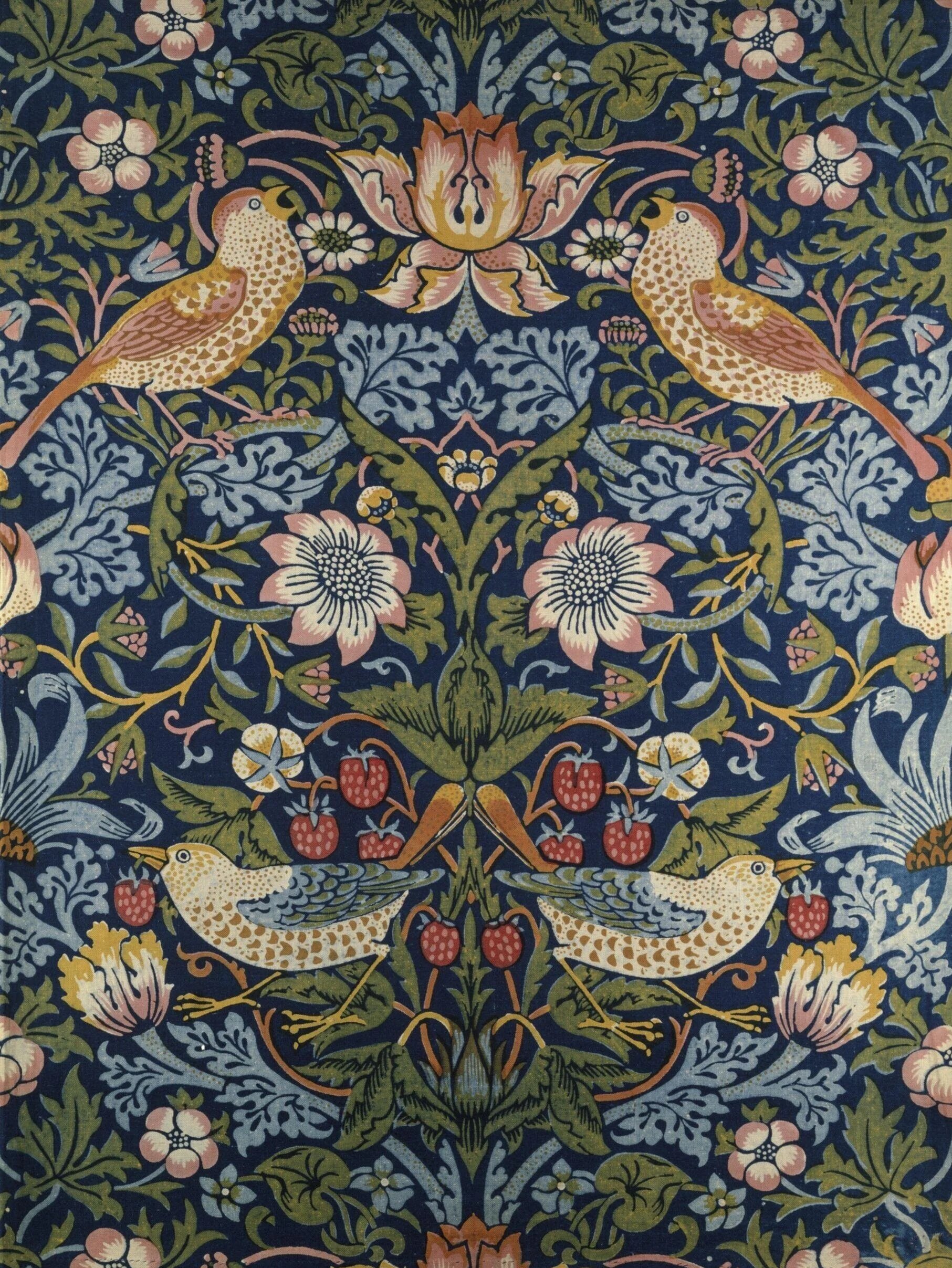
First designed in 1883, 'The Strawberry Thief' is now in the public domain. William Morris drew freely from Asian textile traditions — Islamic, Indian, Japanese, etc. — absorbing their visual grammar into a body of work that made him, and continues to make Liberty London, Morris & Co, and countless others, considerable profit. The communities whose aesthetics he borrowed from were, in many cases, simultaneously being colonised by the empire whose wealth funded his patrons. Their patterns entered the market. Their names did not.
Imperial Fruit Thieves enters this same chain: appropriating Morris's appropriation, itself built on extraction, to document imperial extraction. Each piece replaces his English garden birds and strawberries with flora and avifauna from a specific colonised territory: species endangered or exploited by imperial violence, depicted in the precise aesthetic language beloved by the same system that erased them. The gesture is mimicry in the postcolonial sense, so faithful an imitation that it becomes exposure.

The Long Version
(Featuring ongoing themes from this project that continue to intrigue me)
History & Ecology
William Morris's 'The Strawberry Thief' (1883) is one of the most reproduced textile designs in history. It depicts garden birds stealing fruit from a cultivated English garden, a scene of pastoral abundance, skilled handcraft, and the natural world Morris loved and believed it was his generation's duty to protect. He was a socialist and an anti-industrialist who spent his life arguing that the relationship between maker, material, and time was not inefficiency to be optimised, but the very site of human dignity. He was also the beneficiary of wealth generated by his father's investments in Cornish copper mining.
The ecological argument Strawberry Thieves celebrated was (and still is) rarely applied to the territories the wealth came from.
Imperial Fruit Thieves takes Morris's pattern and turns it back on the system that produced it. Each piece replaces his English thrushes and garden strawberries with flora and fauna native to a specific territory colonised by the British Empire — birds now endangered or extinct, plants driven toward disappearance by monoculture agriculture and habitat destruction, species whose ecological collapse is a direct consequence of imperial extraction.
A significant part of this project's research foundation is Sathnam Sanghera's Empireworld(2024), particularly its account of Kew Gardens: how it functioned not as a place of innocent scientific inquiry, but as operational infrastructure for imperial extraction. Plants were assessed for economic potential, propagated, and strategically redistributed across the empire. Rubber smuggled from Brazil and Palm from Nigeria to establish Malayan plantations. Cinchona taken from the Andes to produce quinine for British troops in India. Tea relocated from China to colonial estates in Ceylon. The garden was a clearinghouse for biological resources whose value had been known for centuries by the communities that cultivated them, and claimed by an empire that had not.
Kew's own archives make this visible in precise detail. Among the Economic Botany Collection's 100,000 objects sits an indigo factory model — clay and wood, commissioned for the 1886 Colonial and Indian Exhibition — depicting a single European manager in a pith helmet watching from above, and 95 Indian workers waist-deep in blue dye. Made to promote the indigo trade to investors: the same trade that forced Indian farmers off food cultivation and into permanent debt. The model sits thirty miles from where this statement was written.
To name, as the Museum of British Colonialism has documented, was to claim. The Reeve’s Pheasant gets its namesake from John Reeves, a British East India Company inspector who collected natural history specimens in China in the early nineteenth century — a reminder that natural history and trade infrastructure were, for the Company, the same operation. The Andean cascarilla colorada became Cinchona succirubra; the Quechua and Aymara communities who had cultivated knowledge of the tree's healing properties for centuries became invisible in the record. Local peoples’ knowledge of their native plants and their labour supporting the empire’s documentation of them was rarely credited if at all.
Extraction dressed as knowledge, and dispossession dressed as discovery.
Ownership & Thievery
'The Strawberry Thief' is in the public domain. This means it is legally available for reproduction, adaptation, and commercial use by anyone. Liberty London uses it on various textiles and goods for profit. This project uses it in critique for artistic fulfilment. But the question of what 'public domain' actually means — who the public is, whose labour created the cultural commons, and who is positioned to profit from it — is one this series refuses to ignore.
Morris's textile designs drew heavily from Persian, Indian, and Japanese pattern traditions — their visual grammar of interlocking botanicals, dense repeating forms, and stylised creatures absorbed into a body of work that made Morris famous, wealthy, and canonical. The communities whose aesthetic traditions he borrowed from were, in many cases, simultaneously being colonised by the empire whose wealth funded his patrons.
Their aesthetics and patterns entered the market, but not their names.
Edward Said named this mechanism orientalism: the West's habit of consuming Eastern aesthetics while subjugating Eastern peoples — extracting the beauty, erasing the origin, presenting the result as an achievement of European sensibility and taste. Morris is not a pure villain in this story (in fact I quite enjoy his works!), but rather a most elegant example of the tension.
Imperial Fruit Thieves enters this lineage deliberately. It appropriates Morris's appropriation — itself built on extraction — to document extraction. The gesture is what postcolonial theorist Homi Bhabha called mimicry: the colonised subject adopting the coloniser's forms so precisely that the imitation becomes destabilising. The pattern looks like Morris. It is structured like Morris. But what it depicts makes the beauty uncomfortable, because the abundance Morris celebrated was not separate from the violence this series documents. It was funded by it.
The provenance chain this series traces runs from unnamed Asian weavers to William Morris to Liberty London to the contemporary moment — in which the logic of extraction has found new materials and new infrastructure, but kept its essential frameworks
The colonial logic did not end, it just found new things to extract
Beauty & Violence
This series is made to be beautiful. That is not incidental to its argument but its very mechanism.
Morris understood that beauty was a form of attention, and that attention was a form of care.
Imperial Fruit Thieves uses the same logic: seduce the viewer with pattern, then reward their attention with layers of meaning that complicate what they are seeing. The decorative is a Trojan horse.
The ecological violence documented here has largely been forgotten — absorbed into the general background of 'development' and 'progress.' The birds are endangered. The plants are gone. The names of the people who tended these ecosystems before empire arrived have been replaced with the names of the men who catalogued them for Kew Gardens.
Beauty is one way to make forgetting harder.
The Garden Museum's Seeds of Exchange exhibition (2026) documents a precise example of this dynamic: John Bradby Blake, working for the East India Company in Canton in the 1760s, commissioned more than 150 botanical paintings from Chinese artist Mak Sau 麥秀, mediated by his interlocutor Whang At Tong 黃遜東. The archive ended up in Virginia. Mak Sau's name took 235 years to reach the title of an exhibition. While the knowledge travelled, the hands that made the art remained invisible.
Colony & Empire
Each piece in this series covers a specific territory — its colonial period, its primary extraction economy, the species damaged or destroyed by that economy, and a colour palette that carries the symbolic weight of what was taken. The series currently spans Africa, Asia, the Americas, the Caribbean, the Pacific, and Europe. It is not finished (and may never be ). New research, new editions, and new collaborators from the territories depicted will be added as the work develops.
The territories depicted are not historical abstractions. The ecological consequences of colonial agriculture are present in the IUCN Red List status of the birds and plants depicted. The cultural consequences are present in the indigenous names that colonial taxonomy replaced — names this series recovers and uses wherever possible. Aotearoa. Turtle Island. Falastin. Xaymaca. To name is to claim; this series attempts to return some of what naming took.
Position & Process
Timelapse of the South Asian edition design process using Procreate
A note on position:
This series was made by CPYC, a design-researcher born in Hong Kong, carrying a Malaysian passport, with a family history shaped by British colonial administration in Malaya. A part-time artist who’s material success and immigration to the UK relied on practices of mimicry - on adopting the habitus of the coloniser. That positionality is not incidental. It’s an authority claim a situated perspective that does not allow the colonial period to be experienced as safely historical. The series does not claim to speak for the communities it depicts. Rather is it a documentation of the artist’s ongoing (un)learnings what was done to them and landscapes they inhabit.
A note on process:
The series is being worked on in two forms: primarily hand-drawn and secondly using AI-generated methods. The comparison is part of the work rather than incidental to it. AI image generators are trained on vast datasets of human creativity, scraped without consent and uncompensated — the same extraction logic, running on newer infrastructure. It is one thread among many in this series' argument about how value is taken, moved, and renamed, and will be documented (beautifully) in time.
References
Sanghera, Sathnam. Empireworld: How British Imperialism Has Shaped the World. Viking, 2024.
Said, Edward W. Orientalism. Pantheon Books, 1978.
Bhabha, Homi K. The Location of Culture. Routledge, 1994.
Antonelli, Alexandre. 'It’s Time to Re-examine the History of Botanical Collections.' Royal Botanic Gardens, Kew, 2020.
Cornish, Caroline. 'Kew and Colonialism: A History of Entanglement.' Royal Botanic Gardens, Kew, 2020.
Barrell, Esme. 'Red Bark and Empire: Unearthing the Colonial Roots of Kew Gardens.' Museum of British Colonialism, 2025.
Garden Museum. Seeds of Exchange: Canton and London in the 1700s. Exhibition, 11 Feb–10 May 2026.