
Nigeria
Annex of Lagos in 1861, followed by the establishment of the Oil River Protectorate in 1884. Merged with The Royal Niger company on 1900, and amalgamated into Northern and Southern Protectorates in 1914. Independence was finally established in 1960
—
Designed digitally with Procreate in 2026,
Physical edition in the backlog
Species featured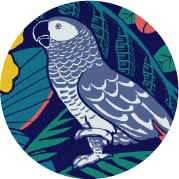
African Grey Parrot
Psittacus erithacus
The African Grey Parrot is among the most cognitively sophisticated birds known to science — capable of vocabulary acquisition, contextual word use, and problem-solving abilities that have made it the subject of decades of comparative cognition research, most famously through the work of Irene Pepperberg with a parrot named Alex. That same intelligence made it one of the most heavily trafficked birds in the world: it has been captured for the international pet trade for over a century, with wild populations in Nigeria and across West and Central Africa collapsing under sustained extraction pressure. It is now listed as Endangered, having declined by more than fifty percent in three decades. The parrot's situation maps with unusual precision onto Homi Bhabha's theory of colonial mimicry — the colonial demand that the colonised reproduce the coloniser's language and behaviour, valued precisely for its approximation of the coloniser's own voice, while remaining permanently other, caged, and owned. A bird prized for sounding like its captor is not a metaphor invented for this series. It is the literal mechanism of the trade that has nearly destroyed the species.
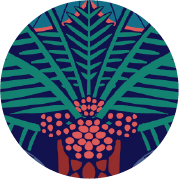
Oil Palm
Elaeis guineensis
Unlike the oil palm of the Malaya edition, where the species was introduced from West Africa as a foreign colonial transplant, in Nigeria the oil palm is native — cultivated and harvested by Igbo, Yoruba, and other communities across the south for centuries before European contact, used in food, medicine, ritual, and trade across the region. British colonial administration did not introduce the crop; it industrialised and extracted from an existing indigenous economy. Palm oil became one of the major commodities of the so-called "legitimate trade" that British merchants promoted as a replacement for the transatlantic slave trade following abolition in 1807 — but the replacement economy reproduced the same extractive relationship in different form, with British trading companies establishing monopolistic purchasing arrangements that depressed prices paid to Nigerian producers while exporting the oil for use in British industrial soap and lubricant manufacturing. The Royal Niger Company, chartered in 1886, built its entire commercial and political authority over the Niger Delta on controlling the palm oil trade — a private company governing a territory through control of a crop that had belonged to the people who grew it for a thousand years before the company's ships arrived.

Yoruba Indigo (Elu)
Lonchocarpus cyanescens
The source plant for Adire, the resist-dyed indigo cloth of southwestern Nigeria — represents an indigenous textile tradition more than two thousand years old, sustained and developed almost entirely by women dyers, the alaro, working in family compounds across Abeokuta and Ibadan, passing dyeing recipes, vat techniques, and pattern knowledge from mother to daughter. The leaves are fermented and worked into dye through a process entirely distinct from Indian indigo cultivation — there is no colonial-era forced cultivation story here, no revolt, no plantation system. What colonialism brought instead was competition: the flood of cheap, mass-manufactured British textiles into West African markets through the same trading infrastructure that the palm oil and cotton trades had established, undercutting the economic position of local cloth production. Adire responded by becoming, in the early twentieth century, a deliberate marker of Yoruba cultural identity and economic independence — cloth as a quiet refusal of imported uniformity. The indigo of this edition is not a story of extraction. It is a story of an indigenous economy that adapted, asserted itself, and survived.

Yellow Trumpet Flower
Tecoma stans / Bignonia species
The yellow trumpet flower grows in dense, vivid clusters across the Nigerian landscape — ornamental, fast-growing, and deeply familiar in gardens, roadsides, and compound walls throughout the south and middle belt. Its visual prominence in everyday Nigerian life makes it a quiet counterpoint to the more loaded extraction narratives elsewhere in this edition: a plant whose primary colonial-era relationship was decorative and horticultural rather than industrially extractive, introduced and naturalised through the exchange networks colonial botanical institutions established across British West Africa. Its presence in this edition serves a different function than the palm or the indigo — not a story of what was taken, but a marker of the ordinary, continuing texture of everyday Nigerian domestic and civic space, the gardens and compounds that exist outside the extraction economy even as they sit within a landscape the extraction economy reshaped.
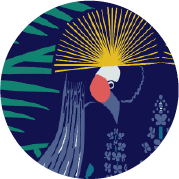
Black Crowned Crane
Balearica pavonina
The Black Crowned Crane — its golden bristle crown radiating like a halo, its call audible across wetland distances — is one of the most visually striking birds in West Africa, and one of the most culturally significant: present in regional folklore, court regalia, and visual art across Nigeria, Mali, and the wider Sahel for centuries. It is listed as Vulnerable, its population in steep decline due to wetland drainage, agricultural conversion, and capture for the international ornamental bird trade and traditional medicine markets — a demand that intensified, rather than originated, under colonial and post-colonial commercial networks that treated the bird as exportable spectacle. The crane requires healthy wetland ecosystems to breed, and the same agricultural expansion and land-use transformation that colonial administration introduced across Nigeria's river basins has steadily reduced the habitat it depends on. A bird that wears its crown without having asked for one — admired, captured, and increasingly absent from the landscapes that gave it cultural meaning.

Kola Nut
Cola acuminata / Cola nitida
The kola nut holds a position in West African — and especially Yoruba, Igbo, and Hausa — social and ceremonial life that has no equivalent decorative status in European botanical history: it is offered at births, weddings, funerals, chieftaincy installations, and virtually every formal social gathering, accompanied by specific ritual language and etiquette that varies by region and occasion. "He who brings kola brings life" is a proverb repeated across the cultures that use it. The kola nut contains caffeine and was, prior to and during the early colonial period, a significant West African export to Europe and the Americas — including, controversially, as one of the original flavouring agents in early Coca-Cola formulations, a connection the Coca-Cola Company has at times acknowledged and at times downplayed. Colonial agricultural policy attempted to formalise and tax kola production for export, treating a substance of deep ceremonial significance as a commercial commodity to be regulated and extracted. The kola nut survived that imposition: it remains, in contemporary Nigeria, simultaneously a global commercial commodity and an essential, untranslatable element of social and spiritual life that no colonial ledger ever fully captured.
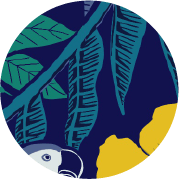
Lagos Mahogany
Khaya ivorensis
Native to the tropical rainforests of West and Central Africa, including the forests of southern Nigeria that gave it its common name. Its timber is among the finest hardwoods in the world: straight-grained, stable, workable, and visually similar enough to American and Cuban mahogany that it became the colonial-era replacement when Caribbean stocks were depleted — a substitution that simply transferred the same extraction logic to a new continent. British and European timber merchants were operating in the Nigerian forests from the late nineteenth century; the Forest Ordinance of 1897, established under British colonial administration, formalised state control over Nigerian forest resources ostensibly in the name of conservation, but in practice prioritised the licensing of commercial timber operations, primarily for export, over the customary forest rights of the communities who had managed those forests for generations. Khaya ivorensis is now listed as Vulnerable on the IUCN Red List, its population having declined significantly from a combination of colonial-era commercial logging, post-independence deforestation for agriculture, and continued illegal and semi-legal timber extraction driven by international demand. The name Lagos Mahogany appears in furniture catalogues and timber merchants' records from the Victorian period to the present.
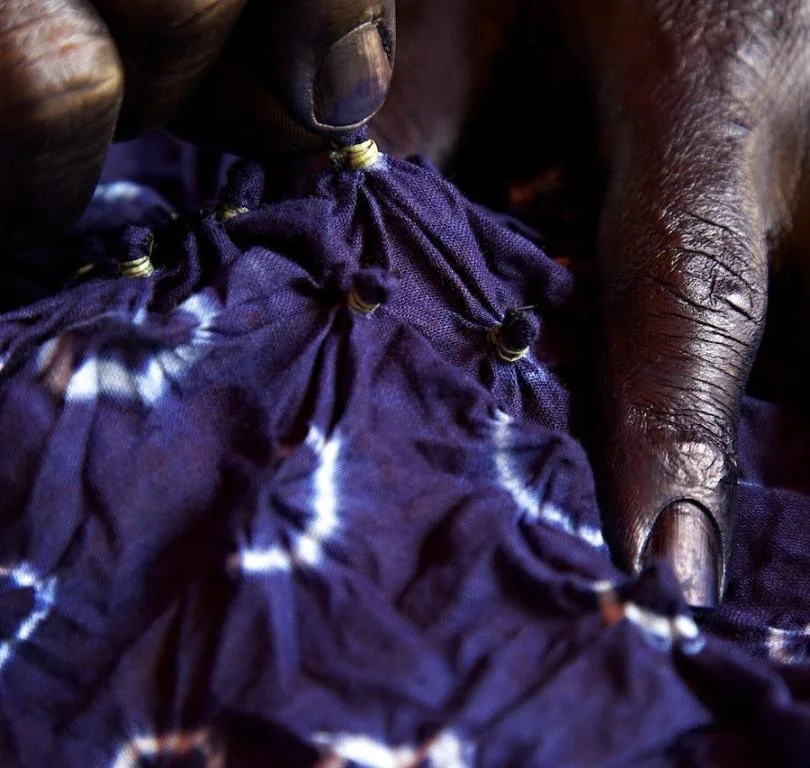
Color ThemeYoruba Indigo
the colour of Adire, the resist-dyed cloth of the Yoruba people, made from elu (Lonchocarpus cyanescens) and produced by women dyers across Abeokuta and Ibadan for over two centuries. Unlike the indigo of the South Asia edition, this is not a story of forced colonial cultivation but a story of an indigenous textile tradition that survived colonial rule, mass-imported cloth, and the erosion of craft economies — and remains, in Adire, a living marker of Yoruba identity.