
Malaya
(Malaysia & Singapore)
Occupied from 1826 - 1957
—
Designed digitally with Procreate 2025-2026,
Published 9 March 2026
Physical edition in the backlog
Species featured
Malayan crested fireback
Lophura rufa
The Malayan Crested Fireback is a pheasant of the lowland rainforest floor, requiring old-growth canopy, undisturbed leaf litter, and the kind of ecological continuity that plantation agriculture systematically destroys. Classified as Vulnerable, its decline maps almost precisely onto the expansion of palm oil monoculture across the Malaysian peninsula: a crop introduced under British colonial agricultural policy, scaled up through the post-independence period, and now the single largest driver of deforestation in the region. The fireback did not survive empire intact. It is losing what remains to the legacy empire left behind.

Gutta Percha (Extinct)
Palaquium gutta
Palaquium gutta was a forest tree of unremarkable appearance and extraordinary utility: its latex, when heated, became mouldable and waterproof, making it the only material available in the 1850s capable of insulating the underwater telegraph cables that connected the British Empire's financial and administrative networks. The demand was instantaneous and total. Collectors entered Malayan forests, tapped or felled every tree they could locate, and extracted latex at a rate the species could not survive. By the early 1880s — within a single decade of the first transatlantic cable — Palaquium gutta was functionally extinct in the wild. Kate Crawford in Atlas of AI draws the line directly from this Victorian environmental disaster to the rare earth extraction driving today's digital infrastructure: the logic is identical, only the mineral has changed. The gutta percha tree was the first species driven to extinction by the information economy.

Palm
Elaeis guineensis
Elaeis guineensis is not native to Malaya — it is native to West Africa, introduced to Southeast Asia by British colonial administrators who identified its industrial oil yield as commercially superior to the region's existing agriculture. The first experimental plantings in British Malaya date to the 1870s; large-scale plantation development followed in the early twentieth century, accelerating through independence and into the present. Today Malaysia and Indonesia together produce roughly 85% of the world's palm oil, on land that was almost entirely primary rainforest within living memory. The colonial decision to introduce a foreign monoculture crop to Malayan soil for British commercial benefit is among the most consequential ecological interventions in the region's history — and among the least examined.

Rafflesia
Rafflesia arnoldii
Rafflesia arnoldii produces the largest individual flower on earth — up to a metre across, scentless until it opens, when it emits a smell of rotting flesh to attract the carrion flies that pollinate it. It has no roots, no leaves, no stem; it exists entirely as a parasite within the tissue of Tetrastigma vines, invisible until the moment it blooms. The story of its colonial "discovery" in 1818 follows a pattern that runs through the entire history of Western natural science in Southeast Asia: it was a Malay servant accompanying Stamford Raffles's expedition who first found the flower and brought it to the attention of British botanist Joseph Arnold, whose name — along with Raffles's — was then attached to it in the scientific record. The person who actually found it has no name in that record at all. The pattern has not ended. In November 2025, Oxford University posted about the rediscovery of a rare Rafflesia hasseltii in West Sumatra, celebrating the find without mentioning the Indonesian researchers and local forest ranger who were present — an omission that prompted widespread criticism and renewed debate about academic colonialism in Global North and Global South research partnerships. Oxford subsequently updated the post. The Rafflesia is endangered, its host vines disappearing alongside the primary forest. The naming convention that erases the people who found it is, apparently, more durable.

Rhinoceros Hornbill
Buceros rhinoceros
The Rhinoceros Hornbill — named for the upturned casque above its bill, which amplifies its call through the forest canopy — is a keystone species of the Sundaland rainforests, dispersing seeds across distances no other bird manages. It is also a cultural figure of considerable weight in Dayak and Iban traditions, where its feathers and casque appear in ceremonial dress as a marker of status and spiritual authority. British colonial logging transformed the old-growth forest it depends on into a resource to be cleared, measured, and sold; the deforestation that accelerated under colonial administration fragmented populations that have not recovered. It is now listed as Vulnerable, declining in direct proportion to the forest that remains.

Black Pepper
Piper nigrum
Black pepper had been cultivated across the Malay Archipelago and traded through regional networks for centuries before European arrival — it was, in part, the commercial logic behind the entire Age of Exploration, the spice Portuguese and Dutch traders had sailed to control and that the British East India Company subsequently absorbed into its monopoly system. In British Malaya, pepper cultivation was concentrated in Sarawak and Penang, where Chinese migrant labour — brought in under colonial labour schemes — worked the vines under conditions of debt bondage and limited legal protection. The pepper that seasoned food across Britain and its empire was grown by people who had little choice in the matter and received almost none of its value. Piper nigrum is the oldest and most traded spice in human history; its story is the colonial story in miniature.

Mangosteen
Garcinia mangostana
Garcinia mangostana is native to the Malay Archipelago, where it has been cultivated in forest gardens for centuries — a fruit that requires decades of undisturbed growth and a specific mycorrhizal relationship with old-growth soil to produce at all. It became a colonial obsession: Queen Victoria reportedly offered a reward to anyone who could deliver her a fresh mangosteen, and the fruit circulated through Victorian botanical literature as evidence of the tropics' exotic abundance. What that literature did not record was that the complex agroforestry systems that produced it — Malay and indigenous mixed-garden cultivation, intercropped with dozens of other species — were exactly the kind of land use colonial plantation policy was designed to replace. The mangosteen survived colonialism. The forest gardens that grew it largely did not.
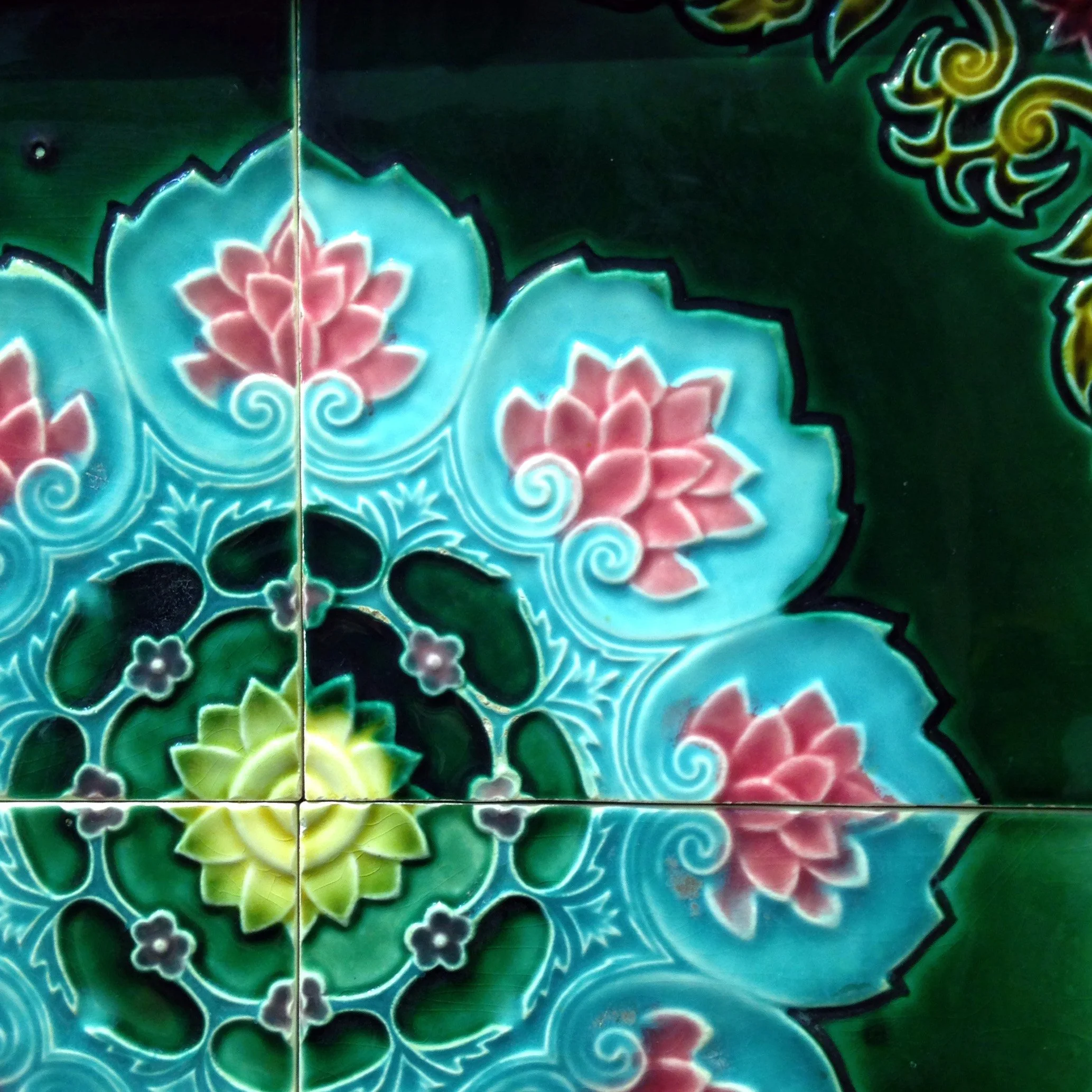
Color ThemePeranakan Teal
Peranakan culture blends southern Chinese and Malay traditions, emerging in the seventeenth century and flourishing under British colonial administration of the Straits Settlements. Under British rule, Peranakan identity became a marker of established, wealthy, English-educated Chinese families who served as colonial intermediaries — distinguishing them from newer Chinese immigrants brought over for rubber, tin, and domestic labour. Post-independence, early Singaporean nationalists suppressed Peranakan identity, though aspects of it — particularly women's dress and material culture — are now selectively celebrated by the Singaporean state as heritage, even as Peranakan individuals face pressure to assimilate into majority Chinese culture.