
Ireland
Occupied 1169 - 1921 until the partition of Northern Ireland and the Irish Free State (“The Republic”).
The Republic departed from the Commonwealth in 1949, though Northern Ireland remains in the Union.
The region is considered by some to be England’s first colony and a laboratory for empire
—
Designed digitally with Procreate in 2026, Published 30 March 2026 Physical edition in the backlog
Species featured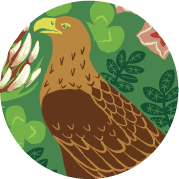
White-tailed Eagle
Haliaeetus albicilla
The white-tailed eagle — iolar mara, sea eagle in Irish — was present in Ireland for thousands of years, a bird of the coastline and the great inland lakes, nesting in sea cliffs and old oak trees whose loss it shared. It was driven to extinction in Ireland by 1910, a casualty of the same forces that cleared its habitat: colonial-era land enclosure, the destruction of the oak forests that provided nesting sites, and direct persecution by landlord-managed game estates that treated raptors as competitors for game. The species was reintroduced to Ireland in 2007, using birds from Norway. Its recovery is partial and contested — shot birds are still found, illegally killed on private land. The eagle that has been back for less than twenty years is navigating a landscape whose transformation took eight hundred.
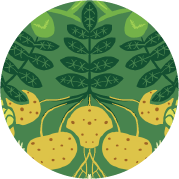
Potato
Solanum tuberosum
The potato is not native to Ireland — it arrived from South America in the late sixteenth century — but its adoption by the Irish peasantry was a direct consequence of colonial land policy: as landlords converted arable land to grazing for the export cattle trade, the potato became the only crop that could sustain a family on the small, poor plots that remained. By the early nineteenth century, a third of the Irish population depended on it almost entirely for calories. When Phytophthora infestans destroyed the crop in successive years from 1845, the result was not simply agricultural failure but the collapse of a food system that colonial economics had engineered into dangerous dependency. A million people died. The British government's response — continuing food exports, maintaining the Poor Law, resisting large-scale relief — has been the subject of debate about whether it constitutes deliberate policy or criminal negligence. The potato did not cause the Famine. The system that made a population entirely dependent on a single crop caused the Famine.
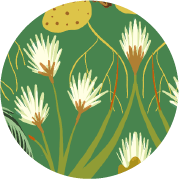
Bog Cotton
Eriophorum angustifoliium
Bog cotton grows across the raised and blanket bogs of Ireland in dense white-tipped colonies that shift in the wind, a landscape feature so distinctive it has become one of the visual shorthand of the Irish west. The boglands it inhabits exist in part because the forests that once covered them were cleared: Ireland's ancient oak forests, among the most extensive in northern Europe in the medieval period, were systematically felled under colonial administration from the sixteenth century onwards for ship timber, barrel staves, iron smelting, and the deliberate destruction of cover for Gaelic resistance. The bogs that formed on the cleared hillsides are ecologically significant in their own right, but they are also a record of what was taken. Bog cotton flowers on a wound.
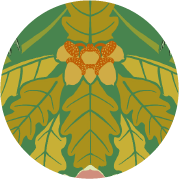
Sessile Oak
Quercus petraea
Ireland was once heavily forested — by the seventeenth century, oak woodland covered an estimated 12% of the island, the remnant of a much larger ancient forest. Under Cromwellian and subsequent plantation administration, those forests were systematically cleared: from ship timber to build the Royal Navy and other military infrastructure, to barrel staves to export salted beef and fish, to charcoal to smelt iron in English-owned furnaces, and as deliberate military strategy — the forest provided cover and sustenance for Gaelic Irish resistance. By 1800 less than 2% of Ireland was forested. Quercus petraea, the sessile oak, is the native species whose loss reshaped the Irish landscape most completely, altering hydrology, accelerating bog formation, and eliminating the ecosystem that had supported red squirrels, pine martens, and white-tailed eagles. Ireland is now among the least forested countries in Europe.
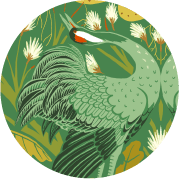
Crane
Grus grus
The crane was once so embedded in Irish life that early manuscripts record it as the third most common pet in the country, after dog and cat, and over a thousand Irish place names carry corr — the Gaelic word for crane — in their roots. It appears alongside the mythological hero Fionn Mac Cumhaill; it is illustrated in the Book of Kells; its distinctive korrr call shaped the names of townlands across Connacht. It was hunted to extinction in Ireland by the end of the seventeenth century, a casualty of the same forces that were simultaneously clearing the oak forests and draining the wetlands it depended on — the systematic colonial transformation of the Irish landscape for timber extraction and agricultural export. It was gone from Ireland for three hundred years. In 2021, a pair bred successfully for the first time since the seventeenth century, nesting on rewetted Bord na Móna peatlands in the Irish Midlands — boglands that had been harvested for industrial peat until 2021, when extraction finally ceased. The crane has come back to a bog that was itself being destroyed until the year of its return.
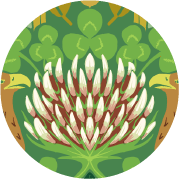
White Clover / Shamrock
Trifolium repens
Trifolium repens — white clover, most commonly identified as the shamrock of Irish national symbolism — is one of the most ordinary plants in the Irish landscape: a common pasture species found in every field, verge, and lawn across the island. Its elevation to national symbol has a colonial dimension that is rarely examined: the shamrock's association with Saint Patrick, and through him with Irish Catholic identity, was cultivated in part as a counter-symbol to British Protestant authority — a claim to a continuous, pre-colonial Irish identity rooted in the land. Under British landlordism, the pastureland it grew on was converted from subsistence tillage to grazing for the export cattle trade, at exactly the period when Irish national consciousness was consolidating around symbols of indigenous identity.
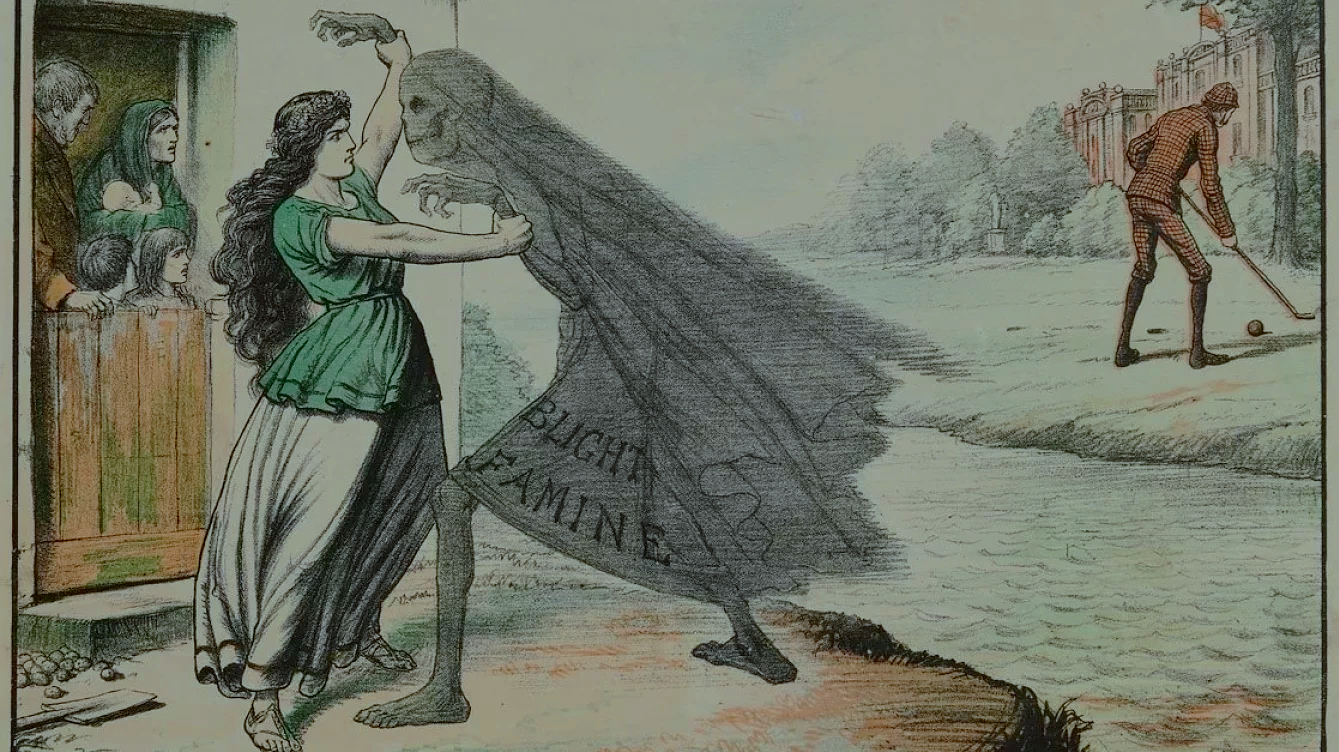
Color Theme“The Emerald Isle” & Famine Green Mouth
Where Ireland’s common characterisation as the 'Emerald Isle' green evokes lushness, abundance, and romantic landscapes, Famine Green references something far more disturbing: the documented testimony of survivors who described people whose mouths were stained green from eating grass, nettles, and seaweed in desperation during the Famine's worst months.