
Hong Kong & China
Occupied 1841 to 1997
—
Designed digitally with Procreate in 2026,
Published 9 March 2026
Physical edition in the backlog
Species featured
Reeve’s Pheasant
Syrmaticus reevesii
Syrmaticus reevesii is native to the hill forests of central and northern China, where it has been hunted and its habitat steadily cleared for over a century. The male's tail is the longest of any bird species, reaching up to two and a half metres. This made it a target for the European decorative trade: Reeve's Pheasant feathers were imported in considerable quantities during the Victorian period for use in theatrical costume, millinery, and the kind of decorative excess the Arts and Crafts movement positioned itself against while remaining thoroughly embedded in. The bird is now listed as Vulnerable, its wild population reduced to a fraction of its historical range through a combination of deforestation, hunting, and agricultural encroachment. It was named by John Reeves, a British East India Company inspector who collected natural history specimens in China in the early nineteenth century — a reminder that natural history and trade infrastructure were, for the Company, the same operation.

Tea
Camellia sinensis
Camellia sinensis has been cultivated in China for over two thousand years — consumed, traded, and embedded in Chinese social and ceremonial life long before European contact. The British East India Company's dependency on Chinese tea, and its inability to pay for it in goods the Qing court wanted, created the structural conditions for the Opium Wars: when China restricted trade at Canton, Britain's response was to flood the market with Indian opium until the trade deficit reversed, then to enforce access by force. The Treaty of Nanking in 1842, signed after the First Opium War, ceded Hong Kong Island to Britain and opened five treaty ports to British commerce. Tea sits at the origin of the entire Hong Kong colonial story and is central to the growth of the wider empire, with colonial tea plantations sprouting as far as India, Ceylon, and Kenya.

Opium Poppy
Papaver somniferum
The opium poppy is not native to China — it was introduced via Arab traders centuries before European arrival — but the British Empire's relationship to it is one of the most deliberate and cynical acts of colonial economic policy on record. Facing a chronic trade deficit with the Qing dynasty, the East India Company began systematically exporting opium grown in Bengal to China in the late eighteenth century, actively cultivating addiction in the Chinese population to generate the silver that would pay for tea, silk, and porcelain. When the Qing government destroyed 1,200 tonnes of confiscated opium in 1839, Britain went to war — twice — to preserve its right to continue the trade. By the 1880s, an estimated ten million Chinese people were addicted. The Qing dynasty — weakened, indebted, and politically destabilised — collapsed in 1912. The poppy that appears in this edition is not metaphor. It is the instrument.

Mulberry
Morus alba
China held the secret of silk production for approximately three thousand years — the cultivation of Bombyx mori silkworms on white mulberry leaves, the unreeling of cocoons, the weaving of thread into cloth — before the knowledge was extracted, by espionage, in the sixth century CE, and again, more systematically, under colonial trade pressure in the nineteenth. British and European demand for Chinese silk was insatiable: it was a primary commodity at Canton, one of the goods the East India Company was buying when it paid in opium. As silk production was gradually established in Britain and India using techniques and knowledge originating in China, the competitive pressure on Chinese weavers intensified. The white mulberry tree — unremarkable in appearance, transformative in consequence — underpins one of the longest and most consequential stories of knowledge extraction in human history. The tree fed the worm that made the thread that made the cloth that William Morris's industry depended upon.

Hwamei / Melodius laughingthrush
Garrulax canorus
The Hwamei — its name meaning "painted eyebrow" in Mandarin, for the distinctive white streak above its eye — has been one of the most prized cagebirds in Chinese culture for over a thousand years, kept for its complex, melodious song and trained to compete in singing contests. This deep cultural significance did not protect it from the colonial and post-colonial trade networks that accelerated its capture: the illegal songbird trade, with roots in the Victorian-era appetite for exotic birds that British colonial commerce helped globalise, has placed sustained pressure on wild populations across southern China and Hong Kong. The Hwamei's decline is not a story of colonial indifference to Chinese cultural practice — it is a story of how colonial trade networks commodified and scaled it.

Bauhinia
Bauhinia blakeana
Bauhinia blakeana is a sterile hybrid — it produces no seeds and can only be propagated by cutting — discovered growing near the ruins of a house on the Hong Kong waterfront in 1880 and subsequently cultivated throughout the colonial botanical gardens. It was named after Sir Henry and James Blake, a colonial governor and his wife. In 1997, at the handover of Hong Kong to the People's Republic of China, it became the emblem on the new Special Administrative Region flag: a flower found by colonial administrators, named after a colonial governor, repurposed as the symbol of post-colonial identity. The Bauhinia's twin-lobed leaf — which resembles two territories joined, or perhaps divided — appears throughout Hong Kong's visual culture.
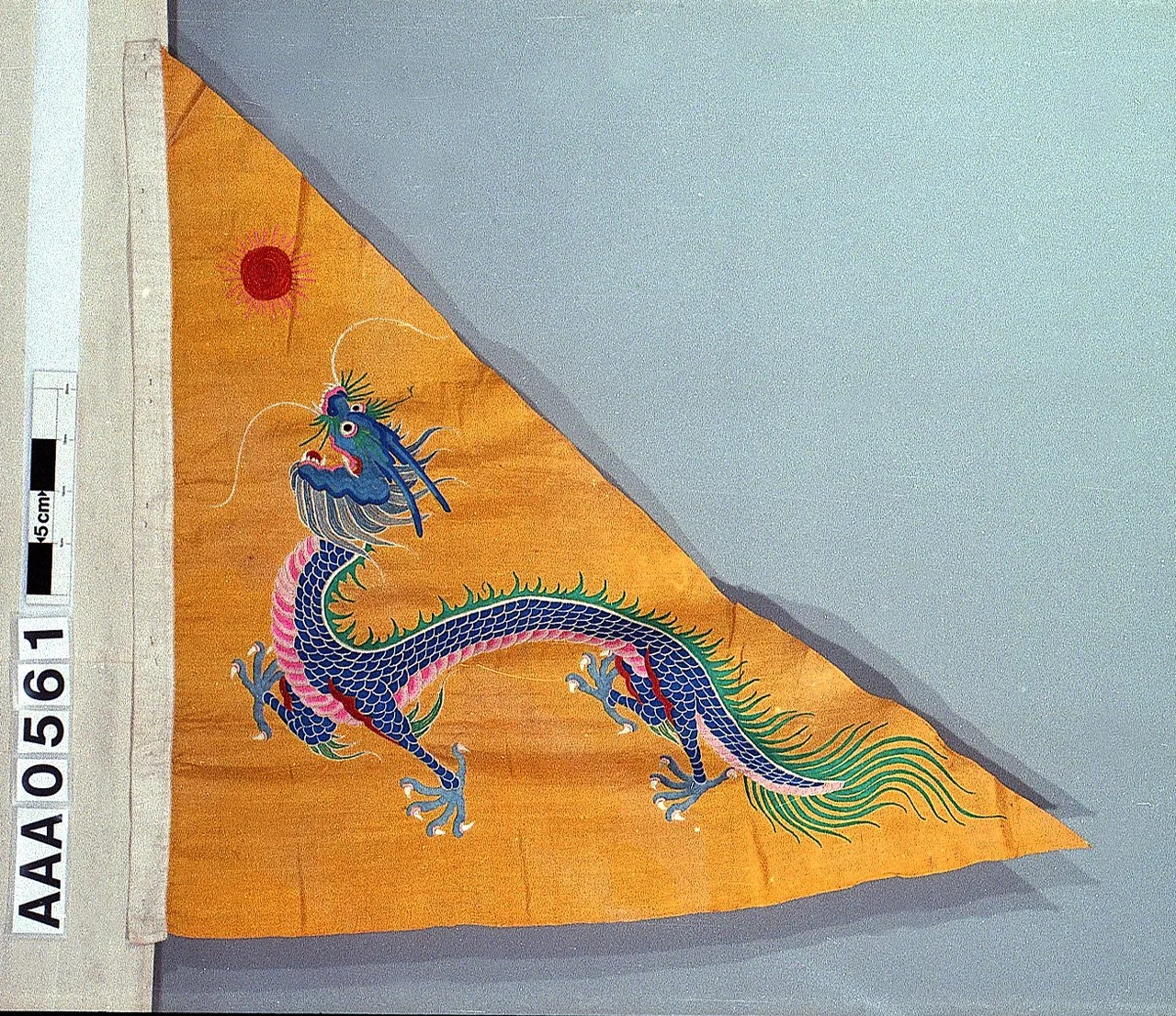
Color ThemeYellow Dragon Flag
(黃龍旗)
The flag of the Qing dynasty was an emblem adopted in 1889 featuring the Azure Dragon on a plain yellow field with the red flaming pearl in the upper left corner. It became the first national flag of China and is usually referred to as the "Yellow Dragon Flag". The Emperors of China often used a Chinese dragon as a symbol of the imperial power and strength.
Photo Credit: National Maritime Museum, Greenwich, London
Further reading
Wong, Winnie. “Seeds of Exchange: Mak Sau 麥秀, Whang at Tong 黃遏東, John Bradby Blake and the Dream of a ‘Compleat Chinensis.’” Garden Museum, 19 Feb. 2026, https://www.gardenmuseum.org.uk/seeds-of-exchange-mak-sau-whang-at-tong-john-bradby-blake/