
Aotearoa
(New Zealand)
Occupied 1840 - 1907 under dominion status
—
Designed digitally with Procreate in 2026,
Published 9 March 2026
Physical edition in the backlog
Species featured
Huia (Extinct)
Heteralocha acutirostris
The Huia was extinct within sixty-seven years of the Treaty of Waitangi. It was a bird of extraordinary singularity: the male and female had entirely different bill shapes — his short and straight, hers long and curved — and they foraged together, each accessing food the other could not reach, a biological interdependence with no parallel among birds. In Māori culture, its tail feathers — black tipped with white — were among the most precious of materials, worn only by those of the highest rank. When the Duke of York visited New Zealand in 1901 and was presented with a huia feather, European demand for the feathers became immediate and insatiable. Collectors, hunters, and the natural history trade finished what deforestation had begun. The last confirmed sighting was in 1907. The Huia is the New Zealand edition's sharpest argument: a species that Māori had lived alongside for centuries, managed through protocols of scarcity and respect, and that European contact destroyed in two generations.

Kōwhai
Sophora microphylla
The kōwhai is among the most culturally significant trees in Aotearoa — its cascading golden flowers marking the arrival of spring in Māori seasonal knowledge, its nectar a primary food source for the tūī and kaka, and its timber used for tools, weapons, and carving. In Māori oral tradition, kōwhai flowering is a signal to plant crops; the tree is part of a calendar of ecological knowledge built over centuries of living in relationship with the land. British settlers recognised its ornamental value immediately and transplanted it into colonial gardens, where it became a feature of the very aesthetic of settler domesticity being imposed on a landscape it had always belonged to. It is now the unofficial national flower of New Zealand — a designation made without formal process, which is perhaps fitting for a tree whose cultural authority was never colonial to assign.

Rimu
Dacrydium cupressinum
Rimu is one of the great trees of the New Zealand rainforest — slow-growing, long-lived, capable of reaching a thousand years old, its weeping branchlets forming a canopy that shelters an entire understorey ecology. Its red-purple seed cones are a critical food source for the kākāpō, whose breeding cycle is triggered by rimu mast years. British colonial timber milling identified it as among the finest softwoods available and cleared it at a rate the forest could not recover from: by the mid-twentieth century, the accessible lowland rimu forests that had covered much of the North and South Islands had been reduced to fragments. The ecological consequences cascaded — kākāpō populations collapsed alongside the rimu that fed them. A tree that had stood for a millennium was gone within two generations of colonial contact.

Harekeke / New Zealand flax
Phormium tenax
Central to Māori material culture for as long as people have lived in Aotearoa: woven into kete (baskets), cloaks, rope, and fine garments whose production required specialist knowledge passed through generations of weavers. The plant itself was understood as a family unit — the central shoot the child, the surrounding leaves the parents, the outer leaves the grandparents — and harvesting protocols required leaving the heart intact. British colonial botanists identified its fibre as commercially superior to hemp and immediately set about establishing extraction industries, employing Māori labour under conditions that bore no relationship to the cultural protocols surrounding the plant. By the late nineteenth century, harakeke was a colonial export commodity. The weaving traditions it had sustained for centuries very nearly did not survive the same period.

Kākāpō
Strigops habroptilus
The kākāpō is a flightless, nocturnal parrot that evolved over millions of years in the absence of land predators, developing cryptic moss-green plumage for camouflage and a booming mating call that can carry kilometres through forest. It had no defence against the animals European settlers introduced: rats, stoats, and cats reached populations that had never needed to fear ground-based predators. By the 1970s fewer than fifty individuals remained. The kākāpō's near-extinction is among the most complete demonstrations of how settler colonialism functions ecologically: the introduction of species, land clearance, and the destruction of the forest food systems the kākāpō depended on operated as a single, compounding catastrophe. It now survives only on predator-free offshore islands, under intensive human management — a bird kept alive by the same civilisation that almost finished it.
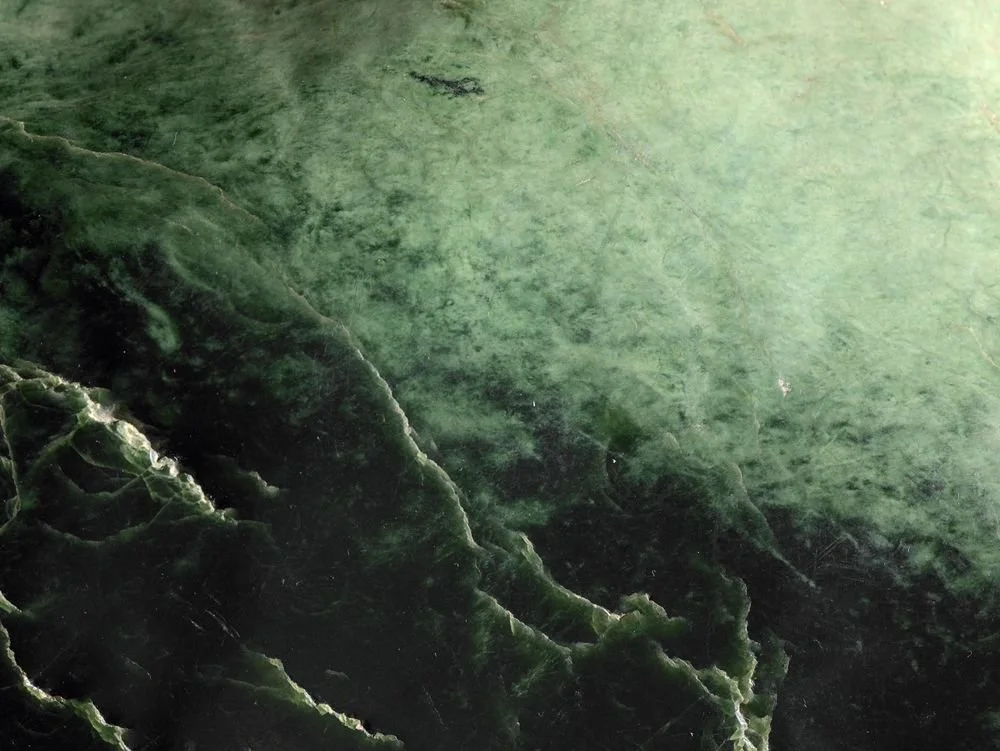
Color ThemePounamu
Pounamu — nephrite jade — was among the most sacred materials in Māori culture: exchanged as taonga, carried as heirlooms, and understood as a living material inseparable from the land and the people who had always held it. The South Island is still known as Te Wahi Pounamu — the place of greenstone. British colonisation placed that land under Crown ownership through the Treaty of Waitangi in 1840, and the dispossession that followed stripped communities of the landscapes where pounamu had always been found. Its deep, quiet green is the colour of something irreplaceable that was taken.
Photo Credit: Museum of New Zealand